Ten years of helping refugee mothers, and no end in sight.
*Trigger warning: rape and childbirth*
Ten years ago, Sally Hyman went to Greece for a month to volunteer in a refugee camp of 700+. There were no NGOs there yet, just a handful of volunteers trying to hold the camp together.
“When I got home, my head was completely f*cked,” Sally said. “Before I left, I told my kids we'd go out for pizza when I got back. And when I got home, I couldn't go out. We live in such different worlds. It was really hard."
"I was enraged. Absolutely enraged. I think it was like - we have to do something.”
That is the reason CRIBS exists. Ten years, six flats, a small team and 117 families housed later, Sally is still working to help women in refugee camps. She never meant for this to become her life's work, she told me, but there is no other choice.
"It feels like - how the hell did we get here? I didn't intend this. But there isn't much way of stopping, really, short of leaving people in the lurch. And there are more and more people in need.”
Why get pregnant in the first place?
Looking chronologically at the journey a woman might take from becoming pregnant to giving birth as a refugee, the part that sits with Sally the most is the reasons women are getting pregnant in the first place.
"If somebody is travelling pregnant, they're less likely to get raped,” she told me. “Sometimes it's a protection method.”
Women are making some of the most dangerous journeys on earth - unprotected by governments - and it is devastating to think this is why many of the women CRIBS supports arrive already expecting or have become pregnant along the way.
Giving birth in a hostile environment: the hospital
Once the woman has arrived pregnant at camp, the biggest challenge is childbirth - but the pain and experience is only half the problem.
The word ‘choice' came up again and again while speaking to Sally. And the total lack of it.
In the Greek hospital system, midwives don't deliver babies, only obstetricians, and many of those doctors also run private practices on the side. A pregnant refugee, hidden away in a segregated ward with no privacy curtains, isn’t a priority and the doctor has his own schedule.
Sally remembers one of the first women CRIBS supported, surrounded by seven or eight medical staff telling her she needed a caesarean. The reason the woman was given? That she had small feet.
"Greece has one of the highest caesarean section rates in the world," Sally says. "Women who don't have good advocacy, or can't communicate because they don't share a language, or have a pushy doctor, get forced into it.”
There is no gas and air. No epidural.
"You're either conscious with no pain relief, or you're unconscious," Sally says. "It's cruel." Greek women can pay for a private room, or quietly hand over what's known as a fakelaki - a "little envelope" of cash - to make sure they're given water, food and pain relief on time.
Then there are the formula companies. Leaving hospital, breastfeeding mothers are routinely handed a small slip of paper, in Greek, that most can't read. It says breastfeeding is best - and underneath, in smaller print, gives the name of a formula brand, alongside a hospital letterhead and an illegible signature.
It is against the law, pure and simple, but it doesn’t stop it from happening. Formula companies exploit new mothers into using their brand, often forcing the baby to become reliant on the milk.
In a country with the most expensive formula in Europe, where clean water for sterilising bottles is often simply not available in a camp, that piece of paper can be the difference between a healthy baby and a very sick one.
Until recently, interpreters were pulled out of the hospitals altogether. Sally describes women whose babies were taken to special care units - sometimes in a different building entirely - with no way of finding out where their child was, what was wrong, or when they'd see them again.
"I can't even imagine how terrifying that must be,” Sally says.
How CRIBS helps
This is the part Sally is most insistent on: naming the problem is only half the story. For every failure in the system, CRIBS tries to put something in its place.
Housing. CRIBS has six flats and takes women in from the third trimester of pregnancy - or earlier, for anyone who's unwell. They will house someone regardless of whether they have papers, even though that's technically against Greek law.
Advocacy in the delivery room. Daphne, CRIBS' lead caseworker, has spent five years building trust with staff at one particular hospital. She tells women not to arrive too early to prevent a forced caesarean and sits with them through labour.
Paying women to breastfeed. For the last twelve months, CRIBS has funded extra food money for mothers who are exclusively breastfeeding, with a bonus at four months. Some people don't like it - "she's doing something natural, why should she be paid for it?" Sally's answer is simple: it's work, it stops you doing other paid work, and it deserves recognition as such.
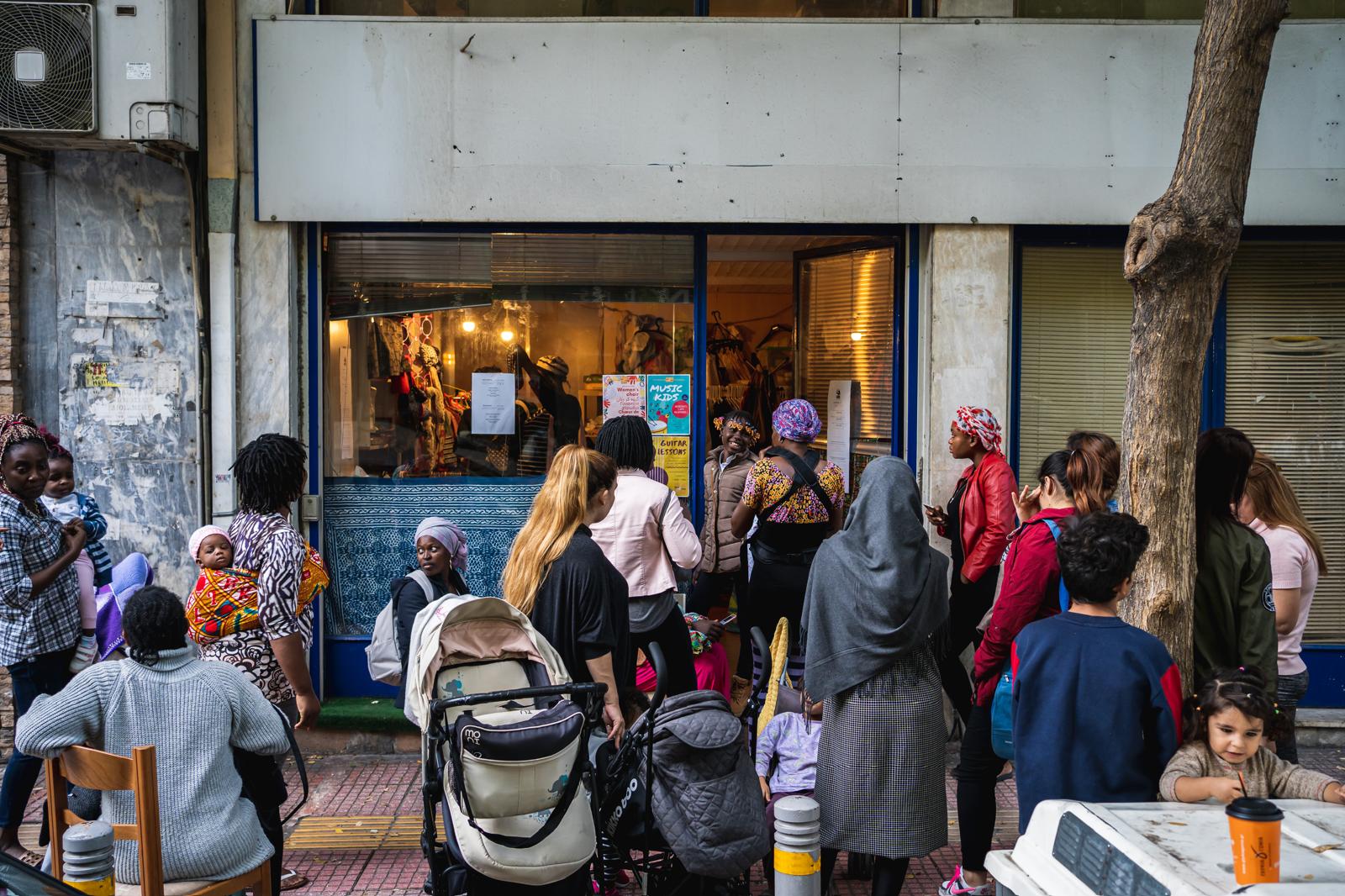
The free shop. Small but open to anyone who needs maternity, baby or kids' essentials, coordinated with other distribution points across Athens so supplies reach as many families as possible.
The unglamorous, behind-the-scenes work. Getting kids into school. Sitting on hold to get an electricity bill reinstated after a neighbour hid it out of spite. Arguing with landlords about blocked drains and broken fridges. Going with someone to a hospital appointment that will eat up an entire day. None of it makes headlines but it's all the work that makes the biggest difference.
The choice CRIBS has to make
Because CRIBS can only take sixteen families at a time, every space is a decision with real consequences.
"At the last referral meeting, we were deciding: do we house a couple with a three-week-old newborn who've just been made homeless, or a couple where she's twenty-eight weeks pregnant and street homeless?" Sally says. "We decided to take the one with the newborn, because the other baby's still safe inside its mother. Or do you take the person who's HIV positive?"
They recently had to turn away a woman with a small baby who was, in Sally's words, "literally enslaved" - living unpaid with a family, caring for their children as well as her own - because technically she had a roof over her head.
But when the referral works, it really does work.
"When somebody moves out with a job, their own flat, the kids in school - that's a champagne moment.”
What’s next?
CRIBS runs on about £9,000 a month, which covers rent, repairs, salaries, food money and electricity bills that are disproportionately high in Greece. Funding has got harder, not easier, over the last ten years. Grant success rates have dropped from roughly one in six to one in twenty. Because CRIBS is UK-registered but works entirely overseas, it's largely locked out of UK corporate giving too, meaning that companies don’t often care about donating to a cause that isn't close to home.
What Sally actually wants, if the money ever allowed it, isn't more of the same but a genuine community. One building to house the families and the charity - with language classes, a shared kitchen, somewhere for people to come together and most importantly, feel safe.
"If anybody wants to give us the money, we do have a plan" she says.
Until then, CRIBS has to keep doing what it has always done - its best to help refugee women suffering in the camps.
If Sally's story moved you, here's how you can help:
- Donate - every pound goes directly to supporting our partners' work with refugees in Greece, France and the Balkans
- Share this article with a friend and raise awareness
- Follow us on Instagram to learn more about our partners and their life-saving work